Technical analysis
A Smooth Slope Is Not One Universal Target
What headphone targets, loudspeaker directivity, and room interaction can—and cannot—tell us about preference.

This article is based on a detailed discussion in The HEADPHONE Community forum. It develops the thread’s ideas into an Informed Listening analysis; the original discussion remains the primary source.
The useful idea inside a familiar slogan
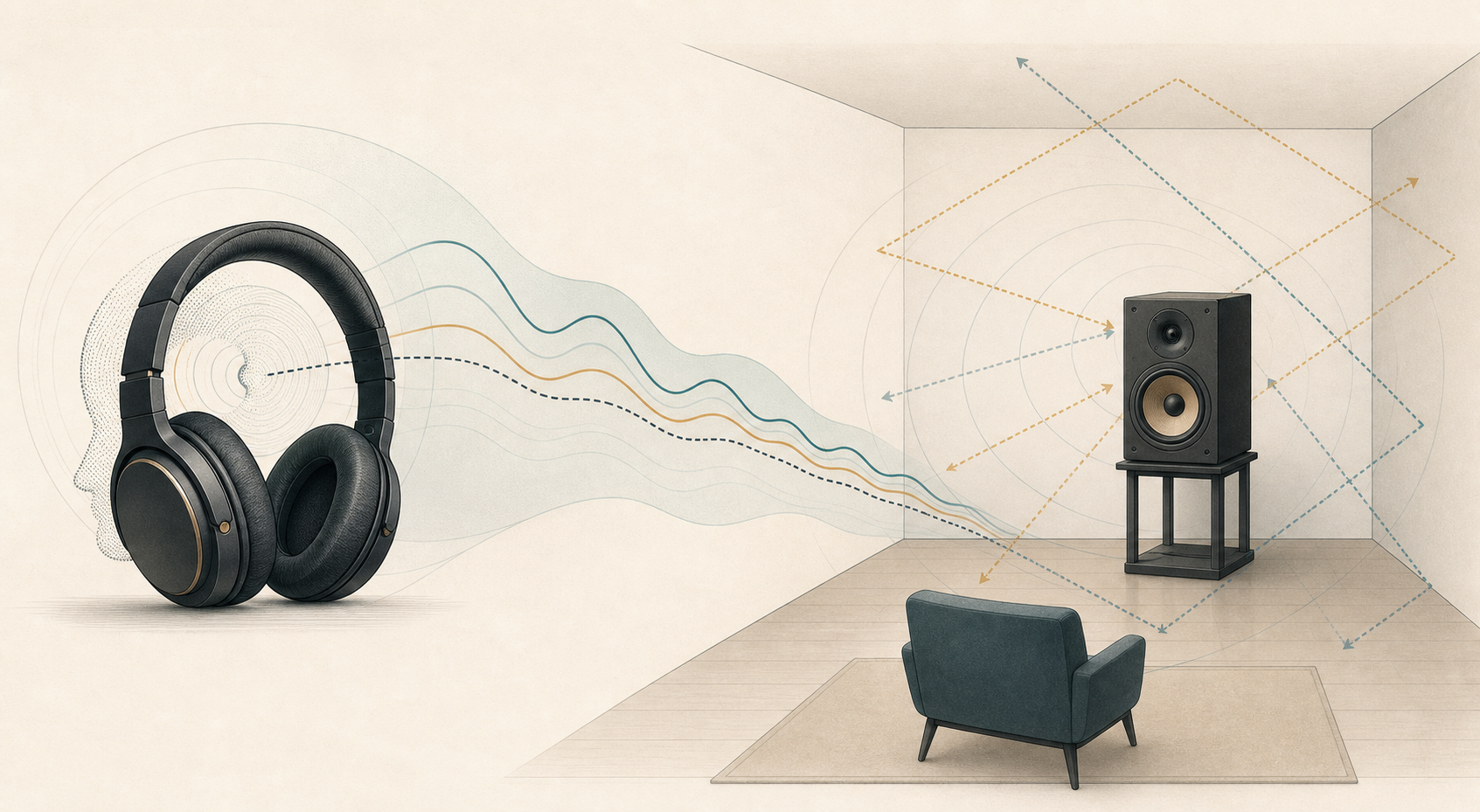
Headphone targets are often described as an attempt to reproduce the sound of good loudspeakers in a good room. The Headphones.com forum discussion asks a more useful question: what parts of that relationship are actually transferable between headphones, IEMs, and loudspeakers?
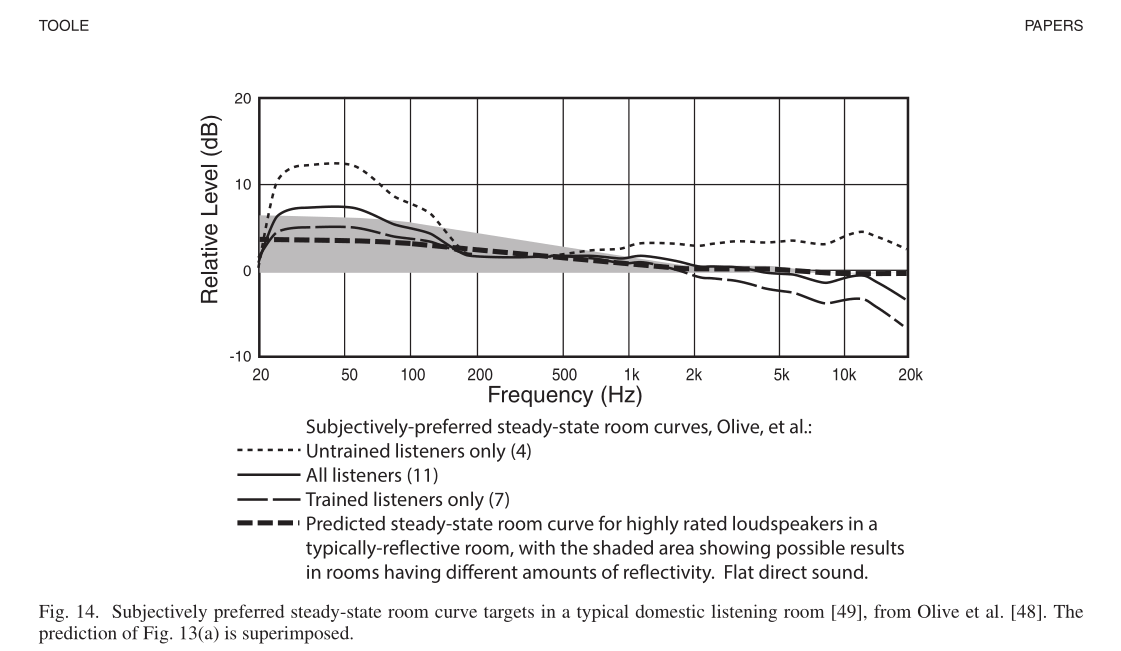
The discussion suggests a cautious answer. Preference may correlate with a smooth spectral trend—a gentle downward tilt rather than a perfectly flat line—but the trend is a reference for investigation, not a universal target that every transducer should share.
Why a downward trend can be a useful reference
The forum discussion points to the directivity of musical instruments and loudspeakers. Their radiation is not constant with frequency, but a broad upward change in directivity is often more consistent than any one narrow directivity profile. A smooth tilt can therefore be a compact way of describing a preferred balance without pretending that every source radiates identically.
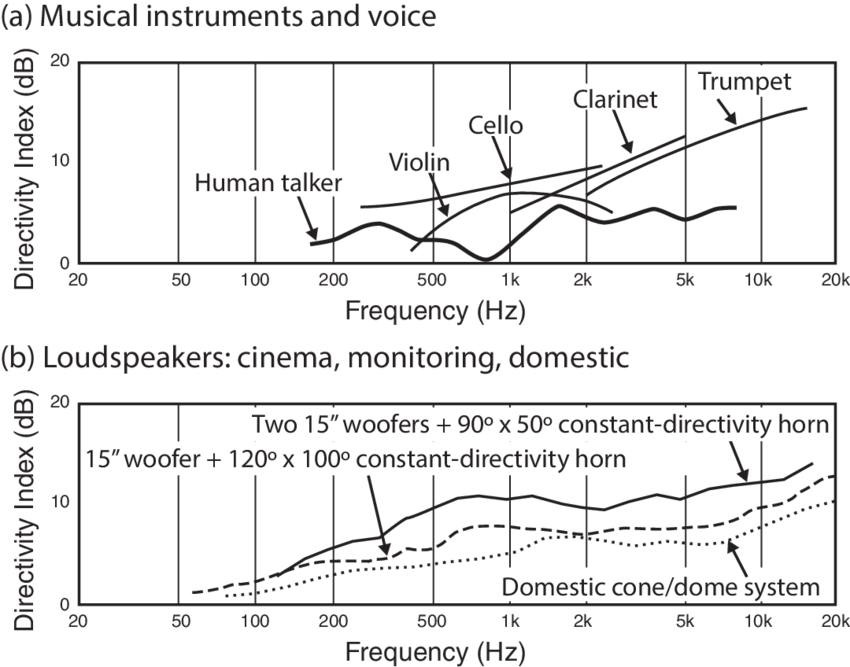
The important word is “smooth”. A target that avoids abrupt changes may be more robust than one that follows a particular loudspeaker’s idiosyncratic directivity. That does not prove that a specific slope—such as the approximately −1 dB/octave convention often shown in headphone work—is correct for loudspeakers or IEMs.
The two things that should not be collapsed
There are two separate questions:
- Does a broad spectral shape correlate with preference?
- What measurement best represents that shape for a particular transducer and listening environment?
The first may have a useful cross-transducer relationship. The second does not have one universal answer.
Headphones and loudspeakers couple differently
For headphones, the measurement is dominated by the ear simulator, the headphone seal, the listener’s anatomy, and the chosen target. A frequency-response target can be applied directly to an EQ workflow, although treble personalisation remains a major limitation.
For loudspeakers, the measurement is inseparable from space. Direct sound combines with early reflections, later reverberation, boundary effects, and low-frequency room modes. The result at the listening position changes with placement and room geometry.
This is why a loudspeaker should not simply be judged against the same literal downward line used for a headphone measurement. The relevant object is closer to a coherent spatial response: smooth on-axis behaviour, controlled directivity, and a predictable relationship between direct and reflected energy.
Minimum phase is not the whole room
A loudspeaker driver and enclosure may behave approximately as minimum-phase systems over parts of their operating range. But the response measured in a room also contains delayed reflections and modal energy. Those arrivals introduce timing information that a single steady-state frequency curve cannot fully represent.
This does not make frequency response irrelevant. It means that a room response must be interpreted alongside time, angle, placement, and level. A good directionally measured speaker can make the reflected sound follow a more consistent tonal pattern, but it does not erase the room’s delays.
What “linear” should mean for speakers
For headphones, “linear” often means close to a chosen listener-related target. For loudspeakers, a useful form of linearity is broader: the speaker should change smoothly as the listening angle changes, with a power response that does not introduce abrupt tonal shifts into the room.
The slope is therefore indirectly related to the listening environment, but not because room width selects a particular dB-per-octave value. Room dimensions affect reflection paths and modes. Directivity affects how strongly those paths are excited. The resulting preference is an interaction between the two.
The missing experiment
The discussion identifies the experiment still needed: measure neutral loudspeakers in semi-reflective rooms at the listener’s ears, then compare those responses with headphone targets and preference data. Without that bridge, claims about a universal transducer slope remain plausible hypotheses rather than established conclusions.
The thread therefore supports a useful editorial position but not a universal specification. A smooth downward trend is a reasonable starting reference for asking better questions about preference. The next question is always how that trend was measured, how the transducer couples to the listener, and whether the room or fit changes its meaning.
Editorial conclusion
A smooth downward slope is a useful reference because it may capture something real about preferred spectral balance and the way natural sources radiate. But it should guide investigation, not replace it.
For headphones and IEMs, use a target as a starting point and account for fit and individual treble perception. For loudspeakers, examine directivity, power response, room interaction, and timing together. The common principle is not one universal line; it is smooth, explainable behaviour under the conditions in which people actually listen.
Source: The HEADPHONE Community forum discussion ↗
The two reproduced diagrams are included for discussion and remain attributed to the original forum post. They are not new measurements by Informed Listening.