Editorial analysis
Reading the Argument Around Headphone Measurements
What a contentious ASR thread reveals about headphone measurement limits, targets, and interpretation.
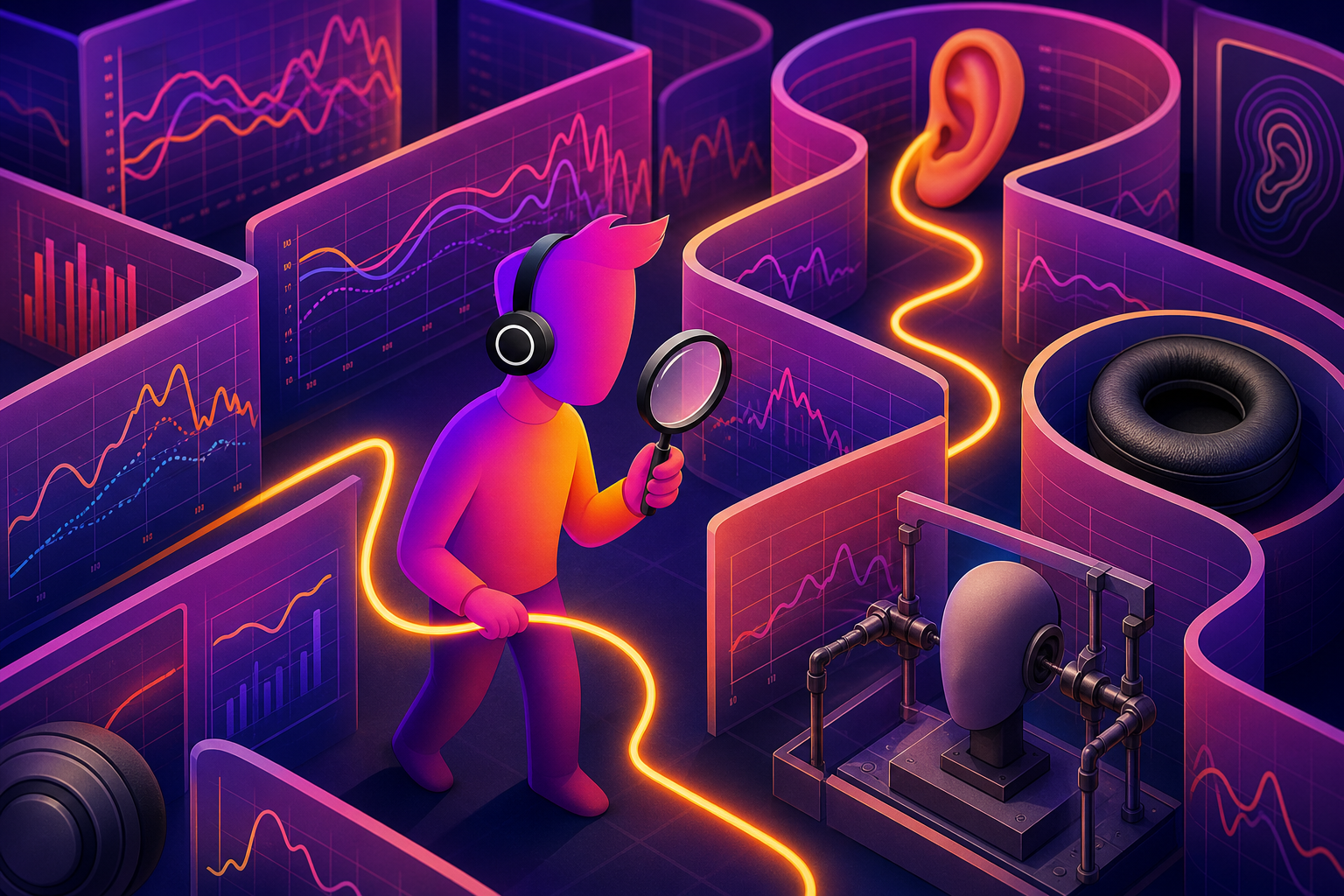
This article is based on a detailed discussion in Audio Science Review’s original thread. It develops the discussion into an Informed Listening analysis; the original thread remains the primary source.
Why headphone graphs provoke more argument
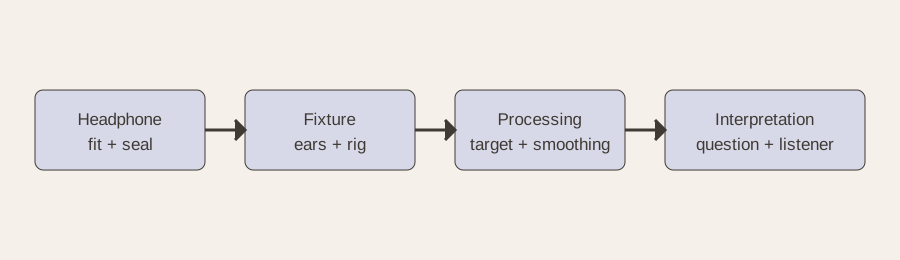
Headphones couple to a human body. Small changes in pad seal, head shape, insertion, and position can alter the result. A graph is therefore not a direct recording of “the sound in your head”; it is a measurement made by a particular fixture, processed in a particular way, and interpreted against a target.
The target is part of the claim
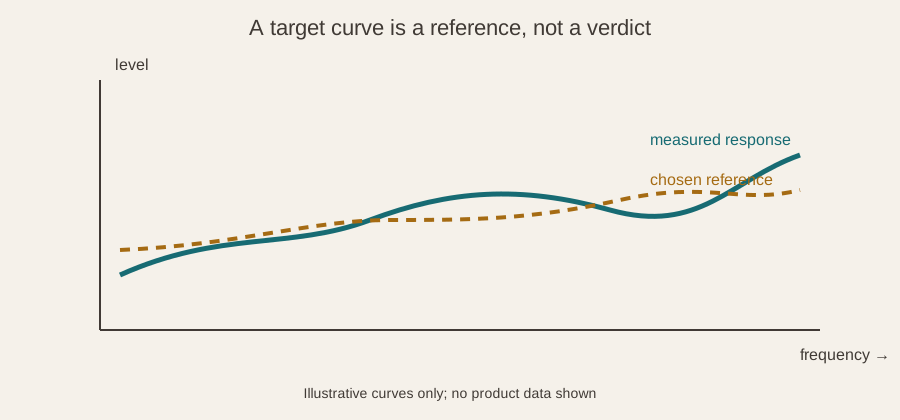
A target curve is a reference for comparison, not a law of nature. It can help describe tonal balance and identify broad deviations, but it does not settle comfort, spatial impression, distortion audibility, or whether a listener enjoys the result. Two competent reviewers can agree on the measured deviation and disagree about its priority.
Measurement quality and measurement usefulness
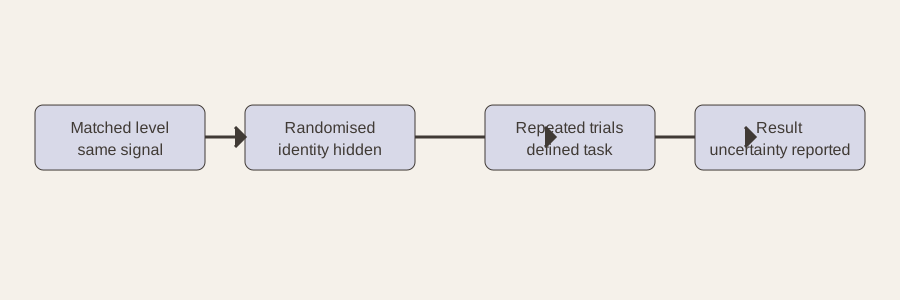
The thread repeatedly circles an important distinction: a technically precise measurement can still be poorly suited to the question. A distortion trace may be valuable for high-level playback, while a response plot may be more useful for EQ. A measurement should be judged by repeatability, uncertainty, and relevance—not by how dramatic it looks.
How to use a review responsibly
Look for patterns across measurements, stated conditions, and listening notes. Treat a large response feature as a prompt to investigate, not proof that every listener will hear the same problem. Check whether the review describes fit and whether the product’s intended use makes the measured limitation important.
The most reliable reading is comparative rather than absolute. Look for the same broad response feature across rigs or repeated measurements, treat narrow treble structure cautiously, and ask whether the fit described by the reviewer resembles your own use. The graph becomes much more useful when it is paired with an explanation of what changed, how large the change is, and whether EQ or a different pad can address it.
Editorial conclusion
Headphone measurement is most useful when it makes the reviewer’s reasoning inspectable. It cannot remove individual variation, but it can expose assumptions, improve comparisons, and make subjective claims more accountable.