Editorial analysis
What Measurements Are For
A practical reading of the long-running ASR debate about measurements, perception, and better buying decisions.

This article is based on a detailed discussion in Audio Science Review’s original thread. It develops the discussion into an Informed Listening analysis; the original thread remains the primary source.
The argument beneath the argument
The subjective listener asks a legitimate question: “What will I hear when I live with this product?” Music is not a laboratory stimulus, and ownership includes comfort, controls, reliability, appearance, and the simple fact that a product encourages someone to listen. Those details cannot be reduced to one distortion figure.
The informed objective listener asks a second question: “What evidence supports that impression, and what else could explain it?” A change in frequency response can sound like a change in detail. A small level difference can sound like an improvement in dynamics. A poor seal can sound like a weak bass driver. Measurement does not replace the first question; it helps prevent the second question from being skipped.
The ASR master thread keeps returning to a deceptively simple question: are measurements everything, or are they nothing? The useful answer is neither. Measurements tell us what a device does under defined conditions. Listening tells us how those behaviours matter in a system, with particular music, at a particular level, and for a particular person.
Evidence is not the same as a verdict
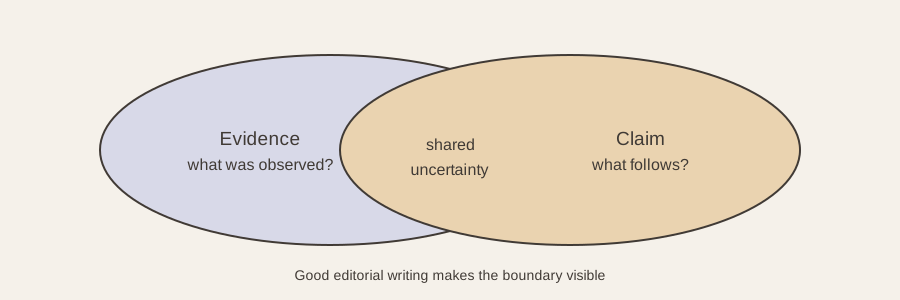
The two listeners can agree on a process. The subjective listener describes the experience in concrete terms: vocals moved forward, bass became less even, the headphone was uncomfortable after an hour, or the amplifier ran out of voltage on a particular model. The objective listener checks which observations can be connected to a response, load interaction, noise floor, output limit, or physical design choice. If no measurement explains the impression, the impression is not automatically false; it is simply a claim that needs a more careful test.
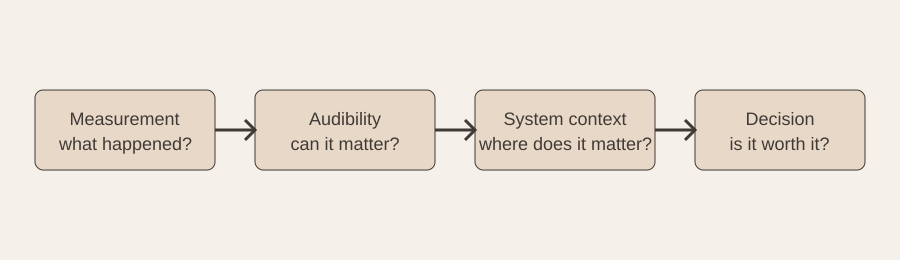
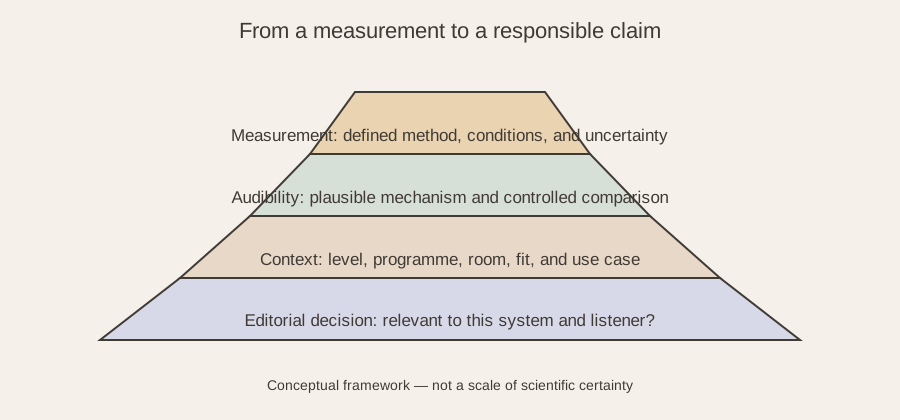
A frequency response, distortion plot, noise figure, or amplifier power result is evidence. It becomes a buying recommendation only after we ask what is audible, what is relevant to the system, and what trade-offs come with improving it. A DAC that exceeds the threshold of audibility may still be worth choosing for its inputs, controls, repairability, or ownership experience.
Why the thread resists a single camp
The thread also discusses how the useful share of measurement changes with the product. Electronics can often be described very thoroughly with electrical tests, while headphones introduce fit, ear shape, pad condition, and target choice. Loudspeakers add directivity and the room. In each case the objective listener has more than one result to consider, and the subjective listener has more than one condition to report.
That is why a review based only on a ranking can be less informative than a review with a lower score but better explanation. The score compresses a decision. The evidence explains it.
One recurring position is that data protects buyers from marketing claims and expensive underperformance. Another is that hobbyists value sound, aesthetics, ergonomics, and the pleasure of ownership—things a single number cannot capture. Both positions contain a sensible concern. The mistake is turning either into a universal rule.
A better buying question
Instead of asking whether measurements or listening “wins”, ask: what uncertainty does this measurement remove? If it reveals a response error, EQ may address it. If it shows an amplifier will clip with a difficult load, power is relevant. If it shows performance already exceeds the audible requirement, spend the remaining budget on fit, features, room interaction, or music.
The practical distinction is between a measurement that answers the buyer’s question and one that merely supplies a ranking. If the question is whether a DAC adds audible noise, a noise and distortion suite at several levels is relevant. If the question is whether it will work in a desktop system, output level, inputs, controls, and software support may matter more. The thread’s strongest lesson is to make that question explicit before choosing the graph.
Editorial conclusion
At Informed Listening, this is the position we take. Objective measurements are central because they make claims testable and expose marketing that does not survive inspection. Subjective listening remains essential because products are used by people, in rooms, with real music and real preferences.
The goal is not to choose between the subjective listener and the objective listener. It is to become an informed, empowered listener who can use both: experience to identify the question, measurement to investigate it, and judgement to decide whether the answer matters.
The strongest reading of the debate is measurement-informed listening: use data to narrow the field and expose constraints, then use listening and ownership context to decide among the products that remain. That is not a compromise. It is a more complete model of the purchase.