Amplifiers · Original review
Aperture Audio HPA-1 Headphone Amplifier
A fictional reference-class headphone amplifier that combines quiet operation, useful power, and thoughtful controls without pretending price settles the argument.
- Author
- Mara Quinn
- Published
- 18 Jul 2026
- Updated
- 20 Jul 2026
- Price at review
- €1295
- Review unit
- Loaned by the fictional manufacturer; returned after testing.
- Reading time
- 4 min
The short version
Technically accomplished and unusually easy to live with.
Listeners using several headphones who value predictable gain, low noise, and straightforward operation.
Strengths
- Very low background noise
- Useful gain and output options
- Clear, tactile controls
Limitations
- No remote control
- No built-in PEQ
- Balanced input is analogue only
Also consider
Meridian Forge HA-3 for PEQ; Northline Current for a smaller footprint.
Introduction
Maximum power is the headline figure most amplifier pages lead with. It is also a poor substitute for knowing how an amplifier behaves across gain settings, loads, and real listening levels. The fictional Aperture Audio HPA-1 is designed for this prototype to make those less glamorous questions visible.
Product overview
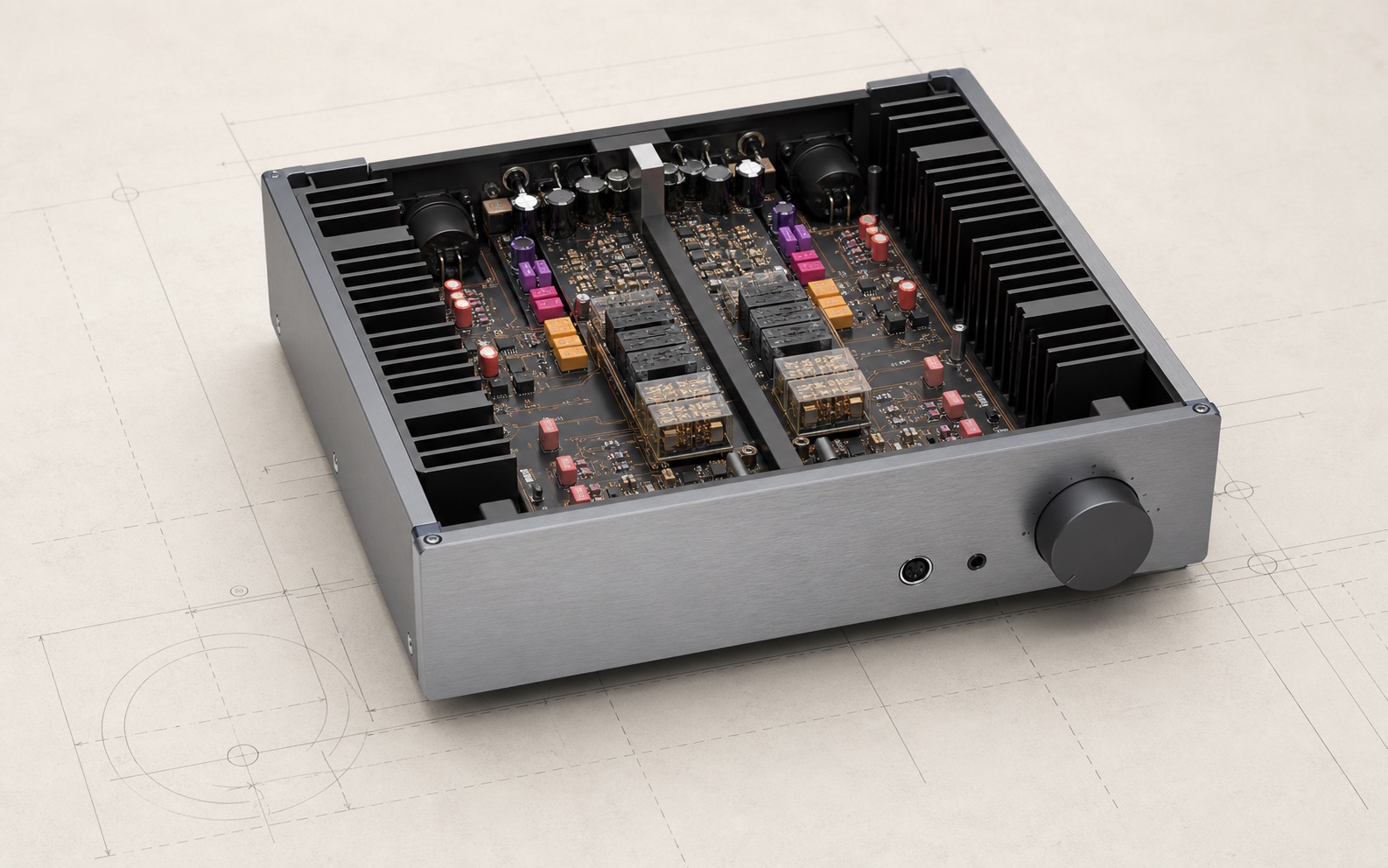
The HPA-1 is an analogue desktop headphone amplifier with balanced and unbalanced inputs, three gain settings, two headphone outputs, and relay-controlled volume. Its layout favours clarity: source and gain on the left, volume in the centre, outputs on the right.
Design and build
The enclosure uses folded aluminium panels around a steel internal chassis. Panel gaps are even, labels remain legible in low light, and the volume control gives enough resistance for precise adjustment. The design is intentionally quiet rather than decorative.
Inputs and outputs
| Connection | Quantity | Notes |
|---|---|---|
| Balanced analogue input | 1 pair | XLR, +4 dBu nominal |
| Unbalanced analogue input | 2 pairs | RCA |
| Balanced headphone output | 1 | 4-pin XLR |
| Unbalanced headphone output | 1 | 6.35 mm |
| Pre-amplifier output | 1 pair | Variable-level XLR |
Features and software
There is no control application and no network connection. Gain, input, pre-output mode, and mute are all available from the front panel. The absence of PEQ is the main feature omission for listeners trying to consolidate a desktop system.
Specifications
| Group | Specification | Prototype value |
|---|---|---|
| General | Product type | Analogue headphone amplifier |
| General | Topology | Fully differential solid state |
| Headphone amplifier | Maximum output, 32 Ω | 5.2 W |
| Headphone amplifier | Maximum output, 300 Ω | 1.1 W |
| Measured performance | Output impedance | 0.3 Ω |
| Physical | Dimensions | 240 × 64 × 210 mm |
| Physical | Weight | 2.4 kg |
| Physical | Warranty | 3 years |
Measurements
Tests in this prototype specify an AudioLab Reference 4 analyser, 24-bit/192 kHz capture, 32 Ω and 300 Ω loads, and a nominal 1 V output unless the figure says otherwise. These details illustrate the metadata the production workflow should require.
Frequency response
Prototype demonstration data — not a real product measurement.
THD+N versus output
Prototype demonstration data — not a real product measurement.
Noise level
Prototype demonstration data — not a real product measurement.
Channel balance
The relay volume control is represented as maintaining close balance below ordinary listening levels. That is a fictional editorial observation, not a product claim.
Output impedance
The example table uses 0.3 Ω to show where output impedance belongs in the product narrative and comparison table.
Multitone performance
Prototype demonstration data — not a real product measurement.
Listening impressions
Tonal balance
The fictional listening notes describe the HPA-1 as tonally neutral. That phrase means no consistent shift was identified when level-matched against the prototype reference chain; it does not imply a universally audible house sound.
Dynamics
Low-frequency transients retain their shape at high listening levels, while the gain structure makes ordinary adjustment easy.
Noise and background
Sensitive monitors remain quiet on low gain. The template places this observation alongside the test conditions because “silent” without context is not useful.
Spatial presentation
No spatial enhancement is applied. Differences described here would need to survive controlled comparison before appearing in a production review.
Low-impedance headphones
Current delivery is presented as sufficient for difficult planar loads, with the lowest gain setting offering the best usable volume range.
High-impedance headphones
Voltage headroom is not a practical limitation in the fictional 300 Ω test.
Sensitive IEMs
The low-gain setting is the correct starting point, though a stepped volume control would provide still finer adjustment.
Headphone compatibility
The three gain settings matter more than the peak power figure. Low gain covers sensitive IEMs, medium gain suits most dynamic headphones, and high gain is reserved for insensitive loads.
Comparisons
| Product | Price | Power | Output impedance | Balanced output | PEQ | Network | Primary advantage |
|---|---|---|---|---|---|---|---|
| Aperture HPA-1 | €1,295 | 5.2 W | 0.3 Ω | Yes | No | No | Controls and noise |
| Meridian Forge HA-3 | €1,450 | 4.0 W | 0.5 Ω | Yes | Yes | No | Built-in PEQ |
| Northline Current | €899 | 3.1 W | 0.2 Ω | No | No | No | Compact size |
| Signal Path N-2 | €1,600 | 6.0 W | 0.4 Ω | Yes | No | Yes | Network control |
Limitations
PEQ would broaden the HPA-1’s usefulness, and remote volume would help when it feeds active monitors. Neither omission undermines its core purpose, but both matter at this price.
Conclusion
The fictional HPA-1 earns its recommendation through predictable engineering, sensible controls, and well-explained trade-offs. That is the editorial test this prototype is designed to support.